Showing posts with label sandbox. Show all posts

Wednesday, August 6, 2014

Flinch and the Defile of Castragon

Xanthus River Valley

The Defile of Castragon is a narrow pass through the mountain range known as the Great Wall located near the small village of Flinch, located in the northernmost region of the Xanthus River Valley near the headwaters of the Flavous River.


The Ancient Trade Road
The road made of cyclopean slab-like paving stones was laid down in ancient times by the Agarthan empire to facilitate trade between the remote kingdoms of the north and the sea-port city of

The Ancient Trade Road

The Flavous River
The Flavous River begins as glacial runoff high in the crags between Mount Zinnober and Nightflame Mountain. It collects in a deep clear lake below the village of Flinch and cascades down a series of several natural multi-step waterfalls before it joins with the Xanthus River to the south.


Bridges
The Agarthans built small stone bridges to cross the many creeks and streams that feed the Flavous River.

The Jetty, Water Wheel, and Flinch. The Manor House can be seen in the upper left.

The Village of Flinch
The village is a small round walled village built in ancient times. It can house 400-500 inhabitants. The land around the village has been cleared of trees for nearly half a mile and is farmed for beets, turnips, potatoes, onions, leeks, and other bulbs and tubers. The farm plots are separated by low fieldstone walls. The village itself has one main gate and a smaller side gate. The walls of the village are built of ancient stone and are quite resilient. There are twenty buildings in the village including a polytheistic temple and a great hall. The village hasn't been ruled by an archon in hundreds of years. Instead, the village is governed by a village elder.
Flinch, the surrounding field walls, and the jetty. The manor lies just off the map to the north.

The Ruined Manor House of the Last Archon
These hilltop ruins overlooking Flinch are all that is left of the estate of the last archon of Flinch. The archon died hundreds of years ago with no heirs. His manor sat abandoned and eventually collapsed. The last archon was an avid hunter and collector of rare beasts. It is said that he kept a menagerie of monstrosities held in magical stasis somewhere in his manor, and that one night they escaped, killing the archon and his household. The villagers believe that monsters haunt the ruins still and refuse to go near it.


The Jetty
The ancient trade road ends at a stone jetty in the lake beneath Flinch. Since ancient times, rafts ferried caravans back and forth across the lake to the western gate, the entrance to the Defile of Castragon.


The Defile of Castragon
A narrow pass that wends for almost twenty miles between Mount Glothacon and Mount Ignoit. A paved road marks the way. Steep mountain slopes rise to either side. At some points the road rises and falls starkly. In ancient times, the pass was patrolled by Agarthan road wardens. No warden has passed this way in centuries. Today, the road is in poor repair, covered in pot-holes and twisted and jumbled in great upheavals of earth. Boulders, landslides, and wash-outs often hinder travelers. In addition, the way is plagued by ogre attacks, hill giants, bandits, griffons, perytons, giant birds of prey, and massive spiders. Despite the dangers, the defile represents the only route through the Great Wall, and merchants are still willing to take the risk.

The Jetty and the ruins of the Eastern Gate

The Eastern Gate
The gates are ruins from the Agarthan era. They were once massive five-story fortified gatehouses to either side of a huge arched gate. They have long ago fallen into ruin, their walls and ceilings collapsed. The skeleton of the arched gate still stands, soaring a hundred feet into the air. No one knows what happened to the cyclopean iron barred doors that once sealed the gate. Legend says they were stolen by a storm giant.


Signal Towers
In ancient times, small signal towers stop atop the ridges overlooking the defile. By shutting the light of a large fire, the guardians of the Castragon could relay messages from one end of the pass to the other. The towers now lie in ruins, occupied only by aerial predators.


The Watchtowers
Two watchtowers once occupied commanding overlooks, allowing unprecedented visibility across the valley to the south and the wastelands to the north. Each watch tower consisted of a citadel and a ten-story tower. A network of subterranean passages connected the watchtowers to the defile thousands of feet below. Today, the eastern tower lies in crumbling ruins while the western tower is said to be occupied by a reclusive wizard.


The Western Gate
The western gate, like its eastern counterpart, lies in ruins. Its great iron gate permanently open, facing the arid wastelands.

Sky-whales

Sky-Whales
The majestic beasts known as sky-whales drift serenely through the mountain peaks of the Great Wall, their thick hides impervious to most predators save the great Roc or Storm Giant hunters. One tribe of Mountain Folk have raised a handful of sky-whales from infants, domesticating them for use as mounts and beasts of burden.


Nightflame Mountain
The midnight-blue stone of Nightflame mountain rises to a height of 14,000 feet, towering over the lesser peaks that surround it.  At night, the summit of the mountain is aglow with a halo of strange witch-fire.


Mount Zinnober
At a height of 13,000 feet, Mount Zinnober looms over the northern mountain-scape. Mount Zinnober is made of reddish-brown stone. It is home to many tribes of orcs, notable for their red skin.

Monday, February 3, 2014

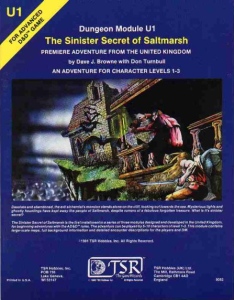
"The Sinister Secret of Saltmarsh" Chapter 6 of the Xanthus River Campaign


First bit of business. During the carnage that was the near TPK last week, everyone forgot that you could spend Luck points to modify your death save. I offered them a chance to retroactively do that. Plus, it was a very unfair scenario and one I was not happy with so I ret-conned a little bit of what happened.

In that light, Nip the turnip farmer did not die. He regained consciousness in the cellar piled with several other bodies waiting for interment. He was assumed dead but had somehow survived! 

The root cellar under the barn showed no evidence of cult activity, nor any sign of a giant skeletal snake demon! It was nothing more than a dark root cellar. Emerging into the light, Nip was told that there was a fight between some out-of-town merchants in the cellar and some smugglers over some bad deal or something. The smugglers were all dead and the merchant and his entourage were getting ready to leave town on their boat. He rushed down and rejoined the boat crew and off they went. 

There was no mention of a cult or battle with the snake demon. It was an odd omission. Was it all a nightmare? An illusion? A cover-up? And what of Gwen the Elf? Her body was nowhere to be seen among the dead. Definitely a mystery for a later date! (and the seed for a future adventure)

Our party now consists of:
Valerius (Level 1 Warrior)
Absalom (Level 1 Cleric)
Nip (Level 0 Turnip Farmer)
Babu (Level 0 Merchant)
Jack (Level 0 Cheese maker)
Shau (NPC)

When we left our intrepid band, they had reached Thither and journeyed on through the night to the mansion of Saltmarsh on the coast of the Smaragdine Sea, where Shau promised a wealthy uncle, a reward, a warm house, fine food, and a comfortable bed in which to sleep. 

Unfortunately, the grounds were overgrown by what look like twenty years of neglect and the house was a decrepit shambles.

WHAT IS GOING ON HERE??

The party entered the house, asking Shau about the layout and nature of the rooms. Shau admitted that she was feeling disoriented and that her memory was mysteriously hazy, but that living areas were in the east wing, studies and libraries in the west wing, and kitchen and servants quarters in the north wing, bedrooms were upstairs.

The team went west, carefully exploring each room in turn. They found a study with a desk and an iron stove. Within the desk they found an unmarked potion. They noted the room as a possible place to rest for the night. Next they explored a living area which had obviously been looted long ago. When approaching the north end of the room, they were startled by a loud ghostly voice hearalding their imminent doom! Several members of the party were frightened out of the room. In a pile of debris they found a large gold hoop earring. The next room was a library, in which they found a few treatises on magic and alchemy. 


Having finished the west wing, they took on the east wing. They found two empty living areas, devoid of interest.


They then entered the north wing. In a drawing room, while searching around the inside of a chimney, Nip was attacked by a large spider the size of a small dog. The party quickly dispatched the arachnid horror. Inside the chimney was a metal box holding a fancy ring.


Next they found the dining room, in which nothing of import was discovered.

In the kitchen they encountered five large aggressive centipedes which scurried from rotted cupboards. In the scullery they found stairs descending to the cellar. When they approached the stairs, they were once again met by a frightening ghostly voice screaming in pain.


At the bottom of the stairs they found the wine cellar. All of the wine had long ago been eaten. In the center of the room was the body of a warrior in plate mail, dead 3 weeks. While investigating the body, Valerius was swarmed by 7 rot grubs! The rest of the party applied fire to the beasts, burning Valerius in the process. Afterwards, Nip found an emerald hidden in the dead warrior’s boot.


While searching the cellar, they noted that the fireplace was made of cemented riverbed stones. A few of the stones appeared to have been chiseled out. Very odd. It was then that they noticed that the back of the fireplace was made of plywood. Even odder!

The plywood easily fell when pushed, revealing a passage through the fireplace. Beyond was a large space filled with beds, barrels of grog, food, and other supplies. It was obviously a well-used living area for up to ten men! Nervous of their chances, the party backed out and returned upstairs to rest.

They nestled down in the study with the door closed. Absalom cast Detect Magic on the party, making note of Valerius' dagger, newfound plate armor, and glowing globe as well as Nip's ring and potion. Afterwards, they went to sleep. In the middle of the night, Nip, who was on guard duty, heard the shuffling and murmuring of voices in the hall. The sounds came closer, then tried to open the door. He quickly woke the others. They opened the door to reveal a small group of four goblins! One goblin was immediately dispatched. At the sight of his dead comrade, another goblin fled. The remaining two goblins stayed and fought. When the second goblin was killed, the forth goblin fled in terror. The goblins, as it happened, were simply scavengers who happened upon the house and were exploring it themselves.

Upon completion of the melee, Nip heard the call of Yigdrassl, the Goddess of Nature. He has decided to become a druid (Level 1 cleric)!

The party returned to their rest.

Next week, the party returns to the hidden cellar chamber, and g…g…g…ghost pirates!!!

Afterthoughts


I'm running the AD&D module U1: The Sinister Secret of Saltmarsh, with some significant story changes. The 1st level monsters are very uninspiring. A spider! Five centipedes! GASP! The rot grubs were a little scary. I don't think any of my players, who are long-time D&D players, had ever encountered rot grubs. I was a little confused how they worked at first. Do they attack? They have an AC of 9 (11 in DCC). Does that mean you have to hit them to apply fire damage? In the end, I ruled that you had to hit them, but just in case I doubled the number of rounds before Valerius would die.

Which leads me to my other failing: turns, turns, TURNS!

Turns != Rounds. Turns equal 10 minutes. Why am I so bad at remembering that distinction! Detect magic lasts two TURNS = 20 minutes, not 20 seconds. Rot grubs kill their host in 1-3 TURNS = 10-30 minutes, not 10-20 seconds.

It's very old school, and I know and understand the distinction, but damned if my brain keeps forgetting.

Similarly, I kept forgetting to invert the armor class of the AD&D monsters. I saw the goblin AC of 6 and thought "wow! pushover!" then I suddenly remembered, "No! 20-6 = a DCC AC of 14!"

I must remember that next week when the party takes on the pirates and their allies!

Friday, January 31, 2014

A Visual Guide to Thither


Thither is a medium-large city of 15 thousand permanent residents and an additional thousand or two transient merchants, sailors, and laborers on any given day depending on the season. Thither is located about four miles from the mouth of the Xanthus river across from the Crying Swamps. Here the river is sluggish and meandering, almost a marshy tidewater.  The swamp itself extends for twenty miles of flooded jungle, marshy grasses, and choking weeds with a multitude of twisting channels.

Thither was constructed by refugees of the doomed city of Sinopia when that metropolis was destroyed one thousand years ago. At first, Thither was nothing more than a fishing village, a collection of hovels, home to five hundred survivors of the celestial holocaust. In time, traders from up-river began to return. Then ships from far off ports along the coast of Agartha, as well as far-off lands like Atlantis, Lemuria, Hyperborea, and Mu, began to stop in Thither. In time, Thither became prosperous and wealthy. The nobility of Thither believe they owe their success to Altina, the golden goddess of the river, and to annual human sacrifice to Bobugbubilz, the god of the swamps.

Like most of the towns and cities of the Xanthus river valley, Thither is ruled by a hereditary Archon who consults with a city council composed of nobles and influential commoners known as Patricians. The current Archon is named Kepha. Kepha is an overweight man in his forties, balding with a well-trimmed beard. Kepha has six wives and eighteen children. Kepha is a practical man but he has little strategic vision. He tends to manage the city one crisis at a time. Kepha is friendly, warm, and generous to his friends. He dislikes having enemies and tries to win opponents over rather than compete with them. Although Kepha is intelligent and astute and brilliant at forging compromises and resolving disputes, many of the patricians consider him weak and tend to work schemes behind his back. This situation has led to hidden corruption within the court of archon Kepha and the city administration.

1. Docks. Wooden platforms and moorings built over the bank allow for up to eight sea-going ships or twenty-four river boats to dock at any one time. The docks are always busy with activity as stevedores load and unload visiting ships.

2. Basilica of Altina, the Golden Goddess of Wealth and Trade. Altina is the patron goddess of Thither. She is depicted as a rubenesque woman made of gold with four arms in which she carries scales, an arrow, a sheaf of wheat, and a crystal orb.

3. The Pylon. This large pylon is connected to the docks by a narrow stone bridge. The bridge prevents loosed boats from floating downriver.

4. Warehouses. The buildings in this part of town consist of warehouses, barns, and storage buildings.

5. Villas. Walled compounds belonging to wealthy patrons of Altina, all of which happen to be successful merchants and moneylenders.

6. Currency Exchange. This temple-like building is home to the impenetrable underground vaults of the money changers. Most trade in Thither is done via notes, IOUs, and scrips, which can be exchanged for currency here. The currency exchange is guarded by an army of alert well-armed guards. The subterranean vaults are patrolled by fabulous guardian beasts, traps, and sorcerous wards. 

The Academy of Eskilik. Next door to the currency exchange is the Academy of Eskilik, an institution of higher learning dedicated to studying the laws and history of the ancient Agarthan empire. The Academy often funds expeditions throughout the valley to locate, explore, map, and recover lost treasures from the ruins of the fallen empire of the golden age.

7. Old South Gate. This older gate allows access through the older inner wall of the city to the newer section beyond.

8. Hostels. Several hostels and inns in this neighborhood provide group accommodation to budget-minded transient boat crews.

9. Patricians Villas. The political elite of Thither hold the hereditary title "Patrician". Those of patrician rank  live in walled compounds near the palace of the archon.

10. Palace of the Archon. Archon Kepha lives in this marble palace with his extended family, household, and regiment of personal guards.

11. Notice Board. A large covered notice board stands in the center of the busiest plaza of the city. Here one may read the day's news, official pronouncements, wanted posters, employment opportunities, and other public notices.

12. Old Temple District. Four temples occupy this row outside the entrance to the archon's palace. Here one may offer sacrifices to seek the blessings of Tzann, the God of the Sun; Pelagia, goddess of the sea; Thumina, goddess of the moon; and the Lazy Issari, demi-goddess of insight and strategy. Each temple is administered by a high priest (Level 10+ Cleric)

13. Monastery of Ulesh, God of Peace. This large walled compound is home to 60 monks overseen by High Llama Sham (Level 9 Monk).

14. Old South Gate. This old gate is covered in bas relief carvings.

15. Tenements. This large four story building is a tenement for the servants and laborers of the city's upper class.

16. Bazaar. Dozens of awnings and tents are erected here everyday in this outdoor market filled with milling throngs, shouting merchants, barkers, exotic performers, and street food.

17. Temples to Justicia and Bilgelik. These two new peripteral temples featuring dozens of gleaming marble columns were built in the last twenty years by wealthy merchant and philanthropist Bo-Mont Oacha.. They are temples to Justicia, Goddess of Justice and Mercy, and Bilgelik, God of Wisdom and Prosperity. The priests and acolytes of these temples endeavor to offer succor for the sick and poor. Their progressive philosophy is very unpopular with the established nobility of the Patricians who occasionally hire mobs of thugs to attack and vandalize the temples and their worshippers.

18. Hospital. Philanthropist Bo-Mont Oacha also constructed this hospital and hired chirurgeons and healing priests of Justicia to tend the wounded gladiators of the arena. The hospital also serves as a school for new healers and chirurgeons.

19. Arena. The small arena of Thither seats 4000 spectators who gather to watch gladiatorial combats, executions, plays, and other performances.

20. Villas. Walled compounds for the families of successful citizens, usually merchants, artisans, and craftsmen.

21. Tenements. Large cheaply-built apartment block-style homes for the city's lower class workers and laborers.

22. Tavern Row. Nearly a dozen taverns are located on this row servicing a mixture of local and visiting clientele. Rowdy brawls are a nightly occurrence.

23. Inns. Several walled compounds provide more secure private accommodation to travelers and their animals.

24. Shops. Artisans, craftsmen, and merchants sell their services and wares from more permanent shops in this lively neighborhood.

25. Garrison and Barracks. The large fortified compound houses the town garrison while the long buildings across the street are the barracks for the troops.

26. North Gate. This gate, built at the same time as the New Outer Wall, provides access to the trail that follows the Xanthus river north to Spit.

27. South Gate. The south gate opens to the coast road which leads south to the town of Orada with side trails to Yon, the "city of wizards".

28. Outer City. These small buildings house inns and shops catering to travelers and river fishermen alike.

29. Signal Tower and Temple of Anuran, Demon-Lord of Amphibians. The fires atop this tall signal tower are used to summon the colossal demon-lord of the frogs to provide him his annual human sacrifice. This annual tradition is believed to keep the city safe by appeasing malicious god and its reptilian and ranine servants.

30. The Crying Swamps. The vast marshes and swamps were once the location of the city of Sinopia, a great port city of the imperial age. Sinopia was destroyed by divine fire over a thousand years ago, leaving nothing but crumbling flooded ruins. Today the region is haunted by eerie wailing spirits and tribes of lizard and frog men.

Sunday, January 19, 2014

"Down the River" Chapter 4 of the Xanthus River Campaign

This week we were joined by a new player: Matt.

As we left our party, they were escorting a merchant down the Xanthus river to the coastal city of Thither. Whilst in Swallow, the merchant hired a river barge to take them the rest of the way down river. Half-a-day out of Swallow, as they passed the confluence of the Xanthus and the Atrous river, 16 pirates in war canoes emerged from the Atrous river and were quickly closing on the party.

The pirates charged closer, gaining on the river barge, closing the distance by 30 feet/round. Valerius the Squire told the captain to slow down and let them get closer, allowing the pirates to gain 40 feet/round. When the pirates got within bow range, three of the pirates began firing longbows. The party, along with the four-man crew of barge, pulled up sections of the deck and used the sections as makeshift shields. The first arrow immediately killed the fat drunken barge captain.

As the pirates were closing, Gwen the elf summoned an eagle (+2 attack, 1d6 damage, AC 12, 2d8 HD, 40' flight), then fired a few volleys from her own longbow. One of the crewmembers, an elfish falconer, let loose his own falcon (+0 attack, 1d4 damage, AC 10, 1d6 HD, 40' fly) on the pirates. The eagle occupied one of the archers while the poor falcon was quickly cut down.  Gwen immediately summoned another animal, this time a pterodactyl (+4 attack, 1d8 damage, AC 12, 4d8 HD, 40' fly) I temporarily forgot you needed a piece of the creature in question to summon it, but I suggested it and Bill went with it).

Ultimately most of the arrows fired by either side went into the river.

Eventually, the canoes came alongside the barge and the pirates used grappling hooks and ropes to begin boarding. Valerius and the crew of the barge (four 0-level PCs played by Matt), set their weapons to receive boarders. Valerius immediately cut down the first boarder in one chop. The sight of the violence sent a shiver of hesitation through the pirates. The pirate captain (4 HD) and his three veterans (3 HD each) chose to hold back and let the younger pirates (all 2 HD) take care of the action (the captain and the three veterans, plus a few pirates, all failed their morale saves).

On the deck of the barge, the battle was furious and fluid. The crew held their own using pitchforks, shovels, and weapons donated by the party. Only one of the crew-members, a farmer, was killed by a pirate. Absalom the Holy Man cast Holy Sanctuary on himself so that he could provide succor to the wounded without impediment, then paralyzed one of the pirates. Gwen found herself near death (down to 1 HP) before repelling the boarders. Having seen the direction the battle had taken, the remaining pirates, their veterans, and their captain, chose to shove off and return up the Atrous River empty-handed.

The party healed their wounds and searched the bodies of the pirates. They looted chain mail armor and scimitars. On one pirate, they found a folded piece of paper.


Afterwards, the party continued down river to Wince. Wince is a small walled river-side village of about 400. The town a tower and keep, and a mill at the end of a long pier powered by a paddle-wheel, and a dock with several river barges and boats.  A group of angry dogs fought on the docks over a fish. The entire area is a patchwork of walled farms dotted with small compounds. While the merchant dealt with the gruff dock-master, the party removed their gear. While doing so, they discovered a woman being held prisoner in the bilge under one of the deck boards. They freed her and discovered that her name was Shau, that she was the daughter of one of the noble families of Thither, and that she was kidnapped by bandits when they raided her home and sold into slavery. The bastard ship captain purchased her six days ago and has kept her bound and gagged in the bilge ever since. She claimed that her family would pay a reward for her safe return!

The party was dismissed to their own recognizance for the evening. They were given group accommodations in the single inn and a stipend for essentials. It was suggested that Shau share a room with Gwen, the crew share a room, and Valerius and Absalom share a room. The party spent the night making plans, eating stew, and drinking ale.

In the middle of the night, Gwen the elf, who was new to having a physical form, woke to a strange new biological urge, a biological compulsion to which she was unfamiliar and by which she was startled and confused. She felt the urgent need to evacuate waste from the lower orifice of her corporeal shell. Confused by this sensation, she asked for guidance and assistance from her roommate. Shau suggested that Gwen utilize the village latrine behind the inn and provided a brief, and awkward, lesson in its usage.

Gwen darted outside and was almost run down by a speeding wagon. Annoyed and covered in mud, Gwen noticed the wagon come to a stop in front of a barn by the river and was met by several cloaked figures, whispering. After taking care of her more pressing needs, she decided to investigate.

She spied a clandestine transaction between four smugglers and half-a-dozen robed and hooded figures. After the smugglers unloaded nearly a dozen clay amphorae and demanded their payment, the hooded figures produced blowguns from their robes and shot each smuggler with a dart, causing them to fall instantly. Startled, Gwen ran back to the inn and roused the rest of the party, including the barge crew.

Geared up and seeing no one, the party of six brazenly approached the barn. Valerius opened the barn door to find a startled figure wearing a hooded robe preparing to exit said door. Both were surprised. After recovering their composure, both angrily demanded to know the others identity and to know what the other was doing here. A section of the wooden floor of the barn was opened, revealing a secret passage to an underground stairway. Annoyed by this stalemate, the robed figure turned to descend down the stairway to get help. Abasalom, thinking quickly, reached out and paralyzed the robed figure with a touch. After binding and gagging their quarry, Absalom noticed a strange tumorous lump in the abdomen of the prisoner. Unnerved by the sight, they left the prisoner alone and descended the stairs.

At the bottom of the stairs was an unlocked door. Opening it revealed a room lit with several glowing braziers. The floor of the room was carpeted in deadly snakes (+1 bite, 1 point damage + poison, AC 11, 1d8 HD, 5' move, 1/2 damage from non-area attacks).

A massive pillar a few feet in front of the door obstructed most of the view of the room. Several bookshelves were visible along the wall to the right. A door guarded by two robed figures stood on the wall to the left. A corridor disappeared around the corner to the far left. A large marble table was on the far wall piled with the bones of what appeared to be a gigantic snake.

A fight ensued, with Valerius battling the enraged snakes, Gwen uselessly firing arrows into the room, and one of the crew members loosing sling stones. One of the guards is immediately killed, another flees down the corridor, the rest fire blowguns at the intruders. Suddenly, a large two-headed snake erupted from the abdomen of the first fallen guard. Absalom doused the snakes in oil and set them ablaze while Valerius decapitated the remaining snakes. Absalom was hit by a blowgun dart and fell immediately unconscious. Depleted of darts and snakes, the guards charged forth, scimitars drawn. Unfortunately, one guard broke his weapon in the attack and the other was cleaved in twain by Valerius' mighty blade. Valerius mocked the other guard, offering his own weapon in order to continue the fight. The surviving guard, as well as his two companions, fled down the corridor. Finally, although it menaced the party, the two-headed abdomen-snake was quickly destroyed by Valerius.

TO BE CONTINUED

Afterthoughts

It was another fun night. The group really seemed to enjoy the river barge fight. The morale rules felt natural and real. It made sense that the veterans became veterans by holding back and knowing when NOT to fight. Heh.

I totally forgot about the requirement of having a piece of the animal to summon. We will remember that next time. We figured an eagle feather and a young pterodactyl weren't out of the ordinary.

In other spellcaster news, Gwen's player can't wait to get to Thither to spend two weeks casting spells: one week for patron bond and one week for summon familiar. The Midkemia Press Cities book has tables for determining what happens to PCs during "down-time" and I can't wait to use them.

As a GM, I enjoy riffing off of player suggestions and also off of random events. In tonight's adventure, the addition of Shau happened when one of the players, Scott, suggested "We should search the captain's cabin, he probably had a prisoner in there." so I said, "There's no cabin, but you find a prisoner in the bilge." Bill absently minded said, "Be careful, she's probably a demon-witch!" to which I replied, "What? No!" and quickly wrote down "Demon-witch?" in my notes.

Likewise, the entire adventure with the cultists came from rolling a mundane random event in the middle of the night: Gwen is splashed by mud from a passing cart. That challenged me right off the bat by asking "Why would this happen in the middle of the night?" and I remembered that Gwen was an elf, and in the world of Agartha, Elves are spirit beings given mortal form in our world. They are unaccustomed to having physical bodies. Everything is new to her, and she has only had a body for 3 or 4 days now. Hey, she has to go to the outhouse! That got her outside.

I could have just left it at that but I had to think of a reason for myself why the wagon was going so fast in a walled village in the middle of the night. It seemed an odd event to me and one likely to provide investigation by a player. So I quickly thought of smugglers and cultists. At first the cultists were just going to be Hollow Ones from the DCC book but Scott said something about them being serpent men! So I changed them to snake cultists!

I always make sure to reward my players for coming up with story points like that. Scott one 1XP for Shau and 1 XP for the snake cultists. Bill got 1 XP for demon-witch idea (whether I use it or not).

In other news, this was our first game with Matt, and he was a great player. I recruited Matt from the G+ DCC Community. We had never met Matt before tonight. He fit right in and did a great job. He added a lot to the group and to the evening and everyone really enjoyed themselves.

By the way, we rolled for Gwen's elfish attributes.
She has pale white skin, white hair, and milky white orbs for eyes. She has two nub horns growing from her forehead.


Next week: room two of the Sinister Secret of the Serpent God!

Wednesday, January 15, 2014

A Visual Guide to Swallow

The town of Swallow sits at the top of the Argent Falls, more commonly known as Silver Falls, where the Xanthus River drops one thousand feet from the highland plateau of Uthu to the lowland jungles of the Sarthrana gorge below. A twenty-foot wide inclined ramp leads up the cliff-face of the gorge, connecting the city to the boat landing below the falls. This strategic location has given Swallow command of all trade and traffic between the highlands and the lowlands. As a result, the people of Swallow have become wealthy and decadent.

Swallow was named for the birds that nest in the cliff-face during the summer months. The flag of Swallow is the silver silhouette of a fork-tailed swallow against a blue field.

The town has a permanent population of 2500 though dozens and sometimes hundreds of travelers may enter and leave the town each week.

Swallow is ancient, constructed 1800 years ago during the early Imperial Age. It boasts an impressive tunnel system beneath its streets to deliver water from the river to underground cisterns and water wheels. The tunnels, passages, and chambers go deep below the city and are often suffer infestations of giant rats, slugs, and beetles, degenerate rat-men and kobolds, and other tunnel-dwelling creatures. The city guard offers a reward (1d6 copper each) for the carcasses of said vermin, with  bonuses for the destruction of an entire warren (1 gold per 20 carcasses delivered at one time).

1. The Argent Falls, aka Silver Falls. The golden waters of the Xanthus river take on a silvery hue as they cascade one thousand feet to the jungle gorge below.

2. The Castle of Archon Hrundinin, Lord of the Swallows. Archon Hrundinin is middle-aged but still athletic and energetic (Level 6 Warrior). He is a plain-speaking man who dislikes double-talk and innuendo. He is sensitive and quick to take offense. Although he is powerful and possesses a harem of 5 wives, he is secretly a profoundly lonely and isolated man with no friends or confidants.

3. The Silver Funicular. This long inclined ramp was cut from the rock face of the gorge by an army of dwarfish slaves during the Imperial age. The ramp is twenty feet wide and over 3800 feet long and features a pair of funicular rails. Each rail hosts a small train of four connected rail cars: first class, steerage, livestock, and freight. Each car is massive, the size of a modern rail car, and is able to carry several tons as long as the opposite train has a similar mass. The weight of water added to the descending car pulls the ascending car. The cars make regular trips, leaving every hour. Use of the funicular costs 1 copper per leg or 1 copper per 100 pounds estimated weight.

4. The Plaza of Horthactus. The large cobblestone plaza serves as a gathering place for townspeople. The amphitheater seats 800 and overlooks the vista beyond the falls. The town often gathers here for official pronouncements, performances, executions, and gladiatorial contests.

5. The Temple of Justica, Goddess of Justice and Mercy. Magistrate Orthat is an elderly priest of Justica (Level 5 Cleric). On the archon's authority, he oversees legal court proceedings within this temple once a week. He has a long beard and a bald head. He is completely devoted to the concept of proper justice. Unfortunately, his assistant, Zhamach, is untrustworthy and corrupt, often accepting bribes or favors. Many merchants and townspeople seek the aid of the temple of Justica to resolve disputes.

6. The Temple Choranus, the Seer Father, Lord of Creation. Father Cteg (Level 5 Cleric) oversees a staff of 10 acolytes and priests. The temple is favored by the craftsmen and farmers of the town.

7. The Temple of Shul, Goddess of the Moon. The temple has a staff of 12 acolytes and 3 priests overseen by Mother Sona (Level 5 Cleric). The temple is popular with hunters and travelers.

8. The Temple of Ulesh, God of Peace. 20 monks study in the monastery attached to this temple overseen by Lama Ulaca (Level 4 Cleric). The temple is popular with scholars and travelers.

9. Patricians Row. This area of the waterfront is comprised of seven walled compounds protecting the mansions and households of the patricians of Swallow.

10. Merchants Row. Common-born merchants who have found commercial success in their transactions have constructed palatial houses here overlooking the river.

11. Workers Row. This neighborhood is home to overcrowded tenements and shanties of the working class. The streets are narrow and clogged with makeshift hovels. The area is rife with crime and is home to the Path of Fear and Thunder, a criminal gang that controls this section of Swallow as a kind of institution.

12. Artisans Row. The craftsmen and artisans of Swallow live and work in this district.

13. Drovers Row. The men who herd the aurochs on the surrounding countryside live in this collection of buildings. The tannery and slaughterhouses can also be found here.

14. The Livestock Pens. Aurochs and mouflon are herded from the surrounding countryside and brought into these livestock pens for slaughter.

15. The Public Bath House and Street Market. The plaza around the public bath house is home to a lively street market covered by tents and awnings. Craftsmen and farmers from all over the valley gather here to sell their wares to traveling merchants.

16. The Barracks. This imposing structure is home to the town guard (level 0-1 men-at-arms), a force of 100 guards commanded by 20 sergeants (level 2 warriors) and Captain Yano (level 4 warrior). Captain Yano is a grizzled cynical veteran in his fifties. He is happily married with fifteen children and is looking forward to his retirement. He is laconic with a gruff exterior but is a keen observer of others with a preternatural sense of what someone is secretly thinking or planning, especially criminals.

17. The Titan's Face. This massive stone face is all that remains of an half-buried statue of an unknown titan. The face is ancient beyond measure. Many myths and legends are told about the mysterious origin of the statue.

18. Bald Knob of Leggach. This area is a large outcrop of bare rock at the top of a hill. The ruins of an ancient castle lie at its apex. The ruins are little more than foundations and tunnels.

19. The Forest of Ath-Bo. The forests of the highland plateau of Uthu are coniferous evergreens. The forests west of town cover the slopes of the mountain known as Ath-Bo, the peak of which is home to the ancient citadel known as the Fortress of the Exile.

20. Hospitality Row. The inns, hostelries, and public houses that cater to the many travelers and merchants that pass through Swallow are found in this small district. Notable institutions include: The Tavern of the Centaurs, The Laughing Auroch, The Silver Funicular, The Gory Sword, et al.

Monday, January 13, 2014

A Visual Guide to Duirndown


1. The Thane's Keep - Home to Lothorn, hereditary thane of Duirndown. The town of Duirndown was a bustling trade center during Lothorn's grandfather's day. Today, much of the keep is abandoned, like the town itself. Lothorn's wife died several years ago, leaving the three children in the care of the nanny, Elichu. 

2. The Dwarf Bridge. The dwarfs of Durinhold built this dam and bridge several hundred years ago. The dam stores water for the mill (12) and the bridge provides access to the  entrance to Duirnhold (3).

3. The Entrance to Duirnhold. Gas-powered flames once burned night and day at the grand entrance to the under-city of Duirnhold. Today the flames are extinguished and the gates are magically sealed. The under-city fell to a massive catastrophe over fifty years ago. The mine boss declared the city off-limits and ordered the quarantine. 

4. The Amber Lake. The lake is forty feet deep and is home to a fish-like lizard called icthys. 

5. Temple of Tzann, the Sun Father, now abandoned.

6. Temple of Thumina, goddess of the moon, now abandoned.

7. Temple of Ordain Stoneshield the Mountain Lord, occupied by a few dwarfish acolytes.

8. The Waterfront. These ostentatious homes and walled compounds were once occupied by wealthy merchants, their families, and households. Many were abandoned over the last fifty years as dwarfish trade disappeared. Many commoners and craftsmen moved into the large drafty buildings before moving back into smaller cozier structures, leaving the edifices to slowly crumble and succumb to broken glass, weeds, and small trees. A few of the merchants still occupy their decaying mansions, shut away from the outside world and slowly going mad.

9. The Inn District. This row of inns, hostels, and bath houses were once busy with traders and travelers. Today, only one public house is still in operation. Most of the other buildings are occupied by the farmers' families.

10. The Stables. Dwarfish craftsmanship constructed underground animal stables built into the side of the hill. The stables are hundreds of years old are are rumored to connect to secret dwarfish tunnels underneath the town.

11. Terraced Fields. The Dwarfs terraced the side of the hill in order to create stepped fields for the humans to grow grains, corn, and potatoes. 

12. The Water Wheel. Water from the dam powers the wheel and in turn drives the mill. 

13. Artisan District. This area once housed skilled artisans and craftsmen and their shops. Carpenters, wainwrights, tailors, dyers, leatherworkers, and coopers once did their business here and lived in the upper floors. Stonemasons, armorers, and blacksmiths found it difficult to compete with the fine work of the dwarfs of Duirnhold. Only a handful of craftsmen remain. The abandoned structures are slowly crumbling.

14. The Oak Tree. This ancient oak tree was planted at the founding of the town over nine hundred years ago. The tree is massive and was once used to execute criminals.


16. The New Fields. This area was once the location of the hovels of the farmers, ditch-diggers, and menial laborers of Duirndown. After the exodus of the wealthy forty to fifty years ago, the poor that remained left their ramshackle homes and moved into the nicer abandoned structures. Eventually, the hovels were torn down and the open lots were turned into additional farming acreage. 

17. The Watchtower. This lone tower stands upon the pinnacle of a nearby hill. From this vantage, one may see the Standing Stones to the north, the Fortress of the Exile to the east-southeast, and the small tower in the village of Choke reaching above the trees to the east-northeast.

18. The Notice Board. This small board in the center of the town square is used to post bills and notices.

19. The Potter's Den. This tall structure, half-built into the side of the hill, was once home to a guild of dwarfish potters, clay workers, and sculptors. Such crafts were seen as unbecoming of a dwarf and were frowned upon in Duirnhold. The inhabitants of the potter's den were considered outcasts from the under-city, and were objects of derision. A few of their descendants remain.

20. The Stone Path. A zig-zagging path lined with paving stones leads down the embankment to the river below the dam. Another path leads up the far side. 

Saturday, January 11, 2014

More info about Duirndown

In the course of last night's adventure, we learned a few more details about the towns and denizens of the Xanthus River Valley.

Duirndown

The city of Duirndown is located near the headwaters of the Xanthus River. Here the river is barely forty feet wide cascading over rocks and small falls. In ancient times, the dwarfs built a dam across the river that also served as a bridge. The town is located on the east side of the dam, the elaborate fortified entrance to Duirnhold on the west side. The dam creates a small lake. A chute in the dam powers a water wheel and mill on the east side.

The town is run by a thane, a hereditary title. Because of the historical importance of trade with the dwarfs, a prominent dwarf was appointed as bailiff. This bailiff served as a sort of second-in-command.

Up until about 50 years ago, Duirndown was a major trade city with a population of around 5000. Merchants from throughout the valley and beyond would come to Duirndown in order to enter Duirnhold and trade with the dwarfs therein. The walled villas and compounds of wealthy merchants dotted the hillside around the town. During its heyday, the town was filled with impressive and imposing architecture that walked up the steep hillside like giant steps. The largest building was the baronial keep, its donjon, and towers.

When the dwarfs of Duirnhold fled their city, the population briefly grew to 11,000. This population was unsustainable and the excess dwarfs settled elsewhere in the valley. Over time, with the lack of trade with Duirnhold, people stopped coming to Duirndown. The wealth disappeared as the merchants and traders moved down to Thither or elsewhere.

Today, the town has a population of 200 and the great stone and marble architecture has crumbled into overgrown ruins, though a few are still occupied by the aged and corrupt denizens who refused to leave. For the most part, the area within the walls is empty. Most of the 200 remaining residents have congregated near the keep at the center of town. All but the largest and sturdiest of the great old buildings have been torn down to clear room for fields and pasture.

The town today has one blacksmith (and one apprentice) and there's not a lot of demand for weapons and armor. There is a wise-man, but no one with real magical or holy powers. The baron is little more than a town mayor and there is no longer a permanent garrison, only a few farmers who have volunteered to stand watch.

Things were greatly shaken up recently when twelve of the town's most able-bodied workers went up the hill to the standing stones because of an old story he heard from the wise-man. Only four returned. Soon afterwards, The four, accompanied by eight others, opened the sealed gate to Duirnhold. Only four returned from that foray. In a town of 200, the loss of seventeen townspeople, almost ten percent of the town's population, was a huge blow! The town has lost its wainwright, several farmers, and other key town positions. Luckily, a few were recent arrivals with a travelling merchant.  The little town has no more potential adventurers to give, and certainly no potential hirelings and henchmen from which to recruit.


"Duirn's Dream" Chapter 3 of the Xanthus River Campaign

Tonight was week three of Dungeon Crawl Classics - the Xanthus River Campaign.

The party emerged from the entrance to Duirnhold with the 9 dead party members from last week's fight with the traps, kobolds, slime monster, and slime zombie. I informed the players of a minor ret-con: the slime was not red, it was in fact black and oily, like tar, and stunk like a self-cleaning oven.

The group now consists of three first level characters:

Valerius the Squire, human warrior

Absalom the Witness, human cleric of Ildavir, goddess of nature
Spells:

  • Detect Magic
  • Holy Sanctuary
  • Resist Cold or Heat
  • Paralysis

Gwen the Wanderer, the elfin archer-mage
Spells:

  • Find Familiar
  • Patron Bond/Invoke Patron
  • Force Manipulation
  • Animal Summoning

Absalom, having heard the call of holy orders, provided burial rites for the slain. The town gathered round the standing stones while the ritual was performed. During the ritual, one of the fallen dwarfs began to leak blood from all orifices, as if all his blood was being pushed from his body. The blood was soon followed by a sticky black ichor bubbling greasy oily bubbles. The body rose, queasily, and lurched towards Gwen, bearer of the magic key that opened the gate to Duirnhold, reaching, grasping.

Gwen backed quickly away and loosed an arrow into the creature. Absalom quickly turned it and the loathsome thing fled. As it did so, Valerius hacked it down. As the animated corpse collapsed into various body parts, the sticky tar that controlled the body slopped onto the ground with a splat, then formed into a lumpy mass with writhing ropy tendrils. The mass continued to move away and was quickly slain.

The rest of the ritual proceeded normally. Afterwards, Absalom cast a Detect Magic spell and identified the fancy dwarfish dagger Valerius carried. It is a +1 dagger with 3 INT that communicates in vague impressions. The dagger is lawful and desires to a) build the greatest city in the world, b) build statues to fallen heroes, c) punish the guilty, and d) punish all thieves. The dagger, like most dwarfs, despises and distrusts users of magic. He names the dagger "Duirn's Dream".

He also identified the demon horn which can be used to summon and bond Ssisssuraaaaggg, the immortal demon-snake. He was not able to identify the proper use of the orb, which as far as anyone known emits a dim light and does not fall when let go.

The party decided to rest for a few days.

That night, I decided to roll for random village encounters in my old book: the Midkemia Press' Second Edition of Cities.

This book was AWESOME with random unplanned stuff!

Day 1, Day- a merchant is in town (random name = Kedrith Wynn) looking to hire guards for his "caravan" (a mule with a strong-box, some un-sold bolts of cloth, and items he's traded for so far). He's reached the end of the road and is heading back down the trail to the port city of Thither. He just lost his former guards in the dungeon and needs new help. He'll pay 6 copper a day to each guard, plus cover food (gruel) and lodhing (common room in the inn). Since that's where the PCs were going to go next, they took the job, leaving on the morrow.

Day 1, Evening - nothing happens. 

Day 1, Night - Absalom is eating at the local inn/public house when the Cities book encounter indicates an old blind beggar (random name = Jacobus) mistakes Absalom for someone else (Sergeant Killroy). I quickly improved a scene whereby Jacobus thinks Absalom is his old commander, "I haven't seen you since the war!" Jacobus ignores Absalom's protestations. to the contrary, "Oh sergeant, you are having fun with me. What are your orders sir?" Eventually Absalom gives in and orders Jacobus to guard the town. "Of course sir! I have been guarding it ever since you left to fight the Troglodytes at the Caves of Deathspire. You said you'd be back in four days. I followed your orders, sergeant. I stayed right here. I've been guarding this town ever since sergeant! And now you're finally back, and I'm reporting for duty!" Absalom took pity on the poor old man. He orders him to fall in on the morrow for a new mission. 

Day 2, Morning - the group gears up. I rolled randomly to see if Jacobus showed up. He did, almost too late. They put Jacobus on Gwen's pony and head off down the trail. No other event indicated.

No wilderness event was indicated on their journey to Choke.

Day 2, Noon - They arrive in Choke, a small walled town where the river narrows into a deep ravine. A bridge crosses the ravine at this location. I rolled an encounter with a town guard who correctly recognizes one of the characters, in this case Gwen. The town guard, Donnan (name supplied by a player), is attracted to Gwen. Gwen tries to hire the guard for the party but he has unfortunately recently taken employment with the baron as a man-at-arms. They have lunch in Choke and continue on. 

Throughout the journey, Valerius won't shut up about the city he's going to build. It will be glorious! A testament to the heroes of old! Etc!

No wilderness event was indicated on their journey to Swallow.

Day 2, Evening - They arrive in Swallow, a relatively large town of 2000, a trading center at the top of the waterfall of the Xanthus River as it cascades from the rugged highlands to the flatter lowlands. A switch-back road allows carts and pack animals up and down the cliff face. I rolled an random event: someone dumps their chamber pot on top of (random) Absalom's head! Absalom, the former gong farmer, is incensed and goes to the local bath-house to wash himself and anoint himself in perfumes and oils.

Day 2, Night - No events.

Day 3, Day - Jacobus is still alive. Kedrith informs the group they are stay an extra day in Swallow to conduct some business. Random event: the circus is in town, but people aren't happy with it. So while kicking around town, a wagon being pulled by a baluchitherium emerges from the cliff-side switchbacks. The wagon is carrying caged slaves, bound and chained, covered in filth. The baluchitherium is in poor health, malnourished and near death. The various traveling gypsies accompanying the small circus set up their act in the town square, where they are booed and people loose interest. 

The party inquires about the circus act. Another random roll later and they engage a local madman, carrying a sandwich-board declaring the imminent end of the world. The madman tells them it is a circus act, and not a very good one. They were much better last year. In addition, "The world will be ending soon! The Oil will consume us all! Beware the Oil! You have been touched by the Oil! Unclean! Foulness! Begone from my sight!" Foreshadowing? Nahh.. What's that mean?

Valerius is annoyed by the state of the slaves, billed as "wild beast-men from the southern jungles" but obviously captured urchins made to look savage, as well as the beast, which he has dreams of riding as a mount. He inquires with the owner of the act, who informs him that times are hard. Pirates raid the river below and he lost his best performers to an attack. He'd be willing to sell the lot for 1000 gold or just the baluchitherium for 100 gold. Valerius declines and goes on his way for now. He informs Kedrith of the pirates. 

Day 3, Evening - No events.

Day 3, Night - No events.

Day 4, Day - Jacobus is still alive. The party loads up and heads down the switchback road. Kedrith hires and boards a river-boat, a wide flat-bottomed barge-skiff manned by 8 oarsmen and a captain. They travel down the wide slow river, surrounded on both sides by a steep gorge and forests. 

No wilderness event was indicated on their journey down-river.

As they approach the confluence of the Xanthus and Atrous Rivers, I decide to intervene with a semi-planned event. They see four swift war-canoes bearing a mixture of human and hobgoblin river pirates bearing down on their river boat.They quickly prepare for boarding action!

We left it there on a cliff-hanger. We're going to pick up next week with the river battle! 

Afterthoughts

I'm totally setting up for a plot arc within Duirnhold. Not a rail-road mind you. This is still a sand-box and the characters can go anywhere and do anything they want. But things are happening off-screen and there are bigger stories afoot. 

In other news, I am LOVING the random encounters of the city book. They are just amazingly inspiring! I had such a good time ad-libbing all the encounters and events and the players did a great job reacting to them and rolling with them. 

I also used some random tables from the Ultimate Toolbox by AEG.


So far, I am having a good time running this game and it seems like my players are enjoying it. 

Saturday, January 4, 2014

"The Kobold's Greeting" Chapter 2 of the Xanthus River Campaign

This week, we met Valerius, the newly graduated 1st level Fighter and sole survivor of the original group of 0-level grunts who entered the funnel last week.

Valerius recruited a new band of 0-level adventurers from the village of Duirndown. One of the adventurers was a dwarf with a magic key that opened the sealed portal that led to the underground realm of King Duirn below the mountain. The dwarves had to abandon their home quickly over two generations ago so no one quite new what to expect.

They opened the portal and right off the bat triggered a large stone block to fall and crush one of the party, followed by a collection of metal dishes, bells, chains, and other loud noise-making junk. Whoever was waiting knew they were coming.

Falling Block Trap: Intelligence check vs. 15 to spot either of the two triggers under a paving stones just inside the threshold of the entrance. Reflex save vs. 10 to avoid. Failure: 1d6 damage and junk clattered to floor.

Beyond the portal was a twenty foot wide stairway with ramps on either side for wagons leading down into the darkness. Walls of rubble and stones were piled up like small walls to slow movement and provide cover to defenders within. The group was soon ambushed by kobolds emerging from blocks moved aside in the walls. The kobolds opened fire with small crossbows. I think the kobolds took out two grunts. The kobolds were hard to get to in their fighty holes and behind their cover. They were -2 to attack.

After the kobolds were defeated, they continued down, only to encounter a giant rolling boulder dropped from the ceiling, ala Raiders of the Lost Ark.

Boulder Trap: Intelligence check vs. 10 to notice the large hole in the ceiling. Once it was set off, make a Reflex save vs. 10. Success, you were uphill. Failure, you were downhill. To outrun it, you had to keep making Reflex saves vs. 5 each round. If you failed, you'd take 2d8 damage. Once someone rolled 15+ on their Reflex save, they made it into the room and the boulder slammed shut behind you.

Four characters hesitated and had to outrun the boulder while the rest were able to move up-hill from it. Two grunts were crushed by the boulder. The other two outran it and made it into a large chamber with a well in the center.

The chamber was supported by three columns. The fourth column had collapsed with part of the ceiling, burying one corner of the chamber in debris. The main passage continued down out of the far wall and two doors lined the walls to each side. A swarm of rats started pouring out of the well.

The characters trapped outside the boulder soon found a secret sally port. After detecting and setting off the kobold trap, they used it to enter the room and help fight the rats. I treated the rats like an amorphous swarm. There were 12 squares of rats that could take on any configuration, attacking anyone adjacent to it. They finally threw a flask of oil on the rats and burned them to death.

Searching down the well, they found a secret passage about 45 feet down. The passage led to an iron vault door with a combination lock: 16 brass buttons arranged in a square. The correct buttons had to be pressed in the correct sequence else you would receive a deadly electric shock.

Vault Door Trap: it is essentially impossible to guess the code. With the code, it was still 50% chance of being wrong. If you guessed wrong, make a Fort save vs. 10. If you failed, you took 1d6 damage.

They left it alone and continued searching. Behind the first door, they found a room with a desk and papers scattered about. Hidden in a secret compartment in the desk was a notebook listing the locations of all the secret vaults in the realm and their combinations. Not how to find them, mind you, just a label and a combination. Unfortunately, the books aid "Vault in Well #1: 3167. Vault in Well #2: 08316". They had a 50/50 chance. They chose poorly and one of the halflings died. The second combo worked, of course.

Inside the vault they found a strong box with 120 silver, a magnificent dagger (possibly magical), and several old books.

By this time, the hoots and taunts of hundreds of massed kobolds could be heard beyond the barricades of the far passage, indicating its relative danger.

Opening the next door, they found an empty store-room. A rotted door on the far wall led to a room filled with offal. Holes in the ceiling were dug by kobolds and used to deposit their filth. Dwarven remains could be seen within the offal. As they approached to investigate, they discovered a hideous red slime covering the piles of excrement. The putrescent slime slithered and oozed towards the party, throwing forth sticky psuedopods. One of the dwarf grunts attacked it only to discover his hammer dissolved by the slime. He was quickly enveloped and dissolved, dropping his torch when went out. On top of that, the remains of the dwarf came to life as a hideous zombie.

They fought a retrograde battle out of the room only to discover three more dwarf zombies emerging from the rubble in the corner. The ensuing battle took out a few more grunts. At one point, the gong farmer used the only remaining torch as a weapon, causing it to go out. The party was plunged into darkness.

Everyone suffered -8 to attack. Those trying to fire ranged attacks blind had a very strong chance of striking their allies. Which they did. Several times. Poor Valerius took the brunt of his own party's damage. Eventually they defeated the zombies and drove the slime back into its den after it failed its morale.

They recovered their torches and discovered that the dwarf zombies carried a total of 17 gold on them.

At this point, there was only Valerius and 3 grunts: a gong farmer, an ostermonger, and an elven sage. The grunts levelled, resulting in a cleric, a thief (maybe?), and an.. elf. They decided to exit the dungeon to tally their loot and re-equip.

I like the idea of the mega-dungeon near town. They can keep exploring it all they want, possibly clearing areas and slowly re-establishing control, like Castle Greyhawk of old. They did not try to establish a foothold this time, but they're thinking about it.

The great thing, for me, was that I completely ad-libbed tonights adventure. I kind of had an idea of what the corridors and rooms would look like, and I quickly wrote down some monsters I wanted to use: kobolds, rat swarm, giant rats, giant snake, wolves, ooze, skeletons, and zombies, plus a few traps. They I just made it up as went along. I need to draw this part of the map before I forget it, then go ahead and draw the next levels of the dungeon.

I can't wait to see what they do next week. It's a sand box so its totally up to them. I gave them several adventure hooks this week to see what they'd do, and they chose the abandoned dwarven city. They're already talking about hiring some 0-level henchmen.

I'm really digging the OSR!

Wednesday, January 1, 2014

Xanthus River Valley

The Xanthus River Valley

Ancient Tunnel, the: once used to connect Duirndown to the city of Sinopia, this tunnel was a shortcut under the steep hills beneath Duirn’s mountain. Additional tunnels connected Duirn’s Realm to the Fortress of the Exile. Today, the tunnel is in ruins and collapsed in places. Many creatures have taken up residence within.

Atrous River, the: the dark black water of this river emerges from the Blackwood forest. It is populated with hideous river monsters, slimes, slugs, and giant snakes.

Blackwood Forest, the: a dark impenetrable forest inhabited by wild beasts and fell monstrosities.

Burned Village, the: once a prosperous logging village in the Blackwood forest, the village was burned down a generation ago by marauders. It is rumored that treasures are hidden beneath its charred remains.

Canyon of Chaos, the: this dry riverbed boasts several extensive cave systems and is home to several tribes of orcs, goblins, ogres, and trolls.

Choke: a walled village on the upper Xanthus river, so-named because the river narrows to a deep gorge. A natural bridge allows access to the Gateway to Elfland.

Crying Swamps, the: the city of Sinopia was destroyed here over a thousand years ago. The resulting marshy swamp is home to lizard-men, ghosts, ghouls, giant snakes, and reptilian horrors. The sound of the unquiet dead can always be heard moaning in the wind.

Dead Forest, the: And entire forest of horrifyingly twisted trees with blood for sap. Anything that dies in the dead forest will rise as a zombie or ghoul.

Defile of Castragon, the: a thin crack, barely wide enough for a horse, allows single-file passage through the Great Wall mountain range. Travelers can expect to be plagued by stone giants, rock trolls, and mountain ogres.

Duirn’s Mountain: The realm of the dwarf king Duirn once prospered under this imposing mountain. The dwarves abandoned the realm three generations ago when monsters overran their defenses.

Duirndown: a small walled village of 200 at the foot of Duirn’s Mountain. Duirndown was once the entrance to the subterranean realm and a major trade center. Today it is an isolated outpost for fur trappers and miners.

Flinch: a remote mining village of 500 at the base of Mount Zinnober, and last outpost for travelers attempting to brave the defile of Castragon. Flinch is surrounded by a wooden palisade.

Fortress of the Exile, the: once a great dwarven fortress built into the top of a rocky outcrop, the fortress was a part of the subterranean realm of the dwarf king Duirn. Today it is abandoned and occupied by all manner of flying creatures.

Gateway to Elfland, the: This mysterious moor contains an arcane portal to the otherworldly realm of the elves. The portal opens every full moon. Magical energies from this place cause mutations in the surrounding wildlife.

Great Wall, the: a towering mountain range that prevents passage from the valley to the wastelands beyond. The only ways through lie at the pass through the Witch-Moor and the Defile of Castragon.

Griseous River, the: a slow syrupy river with dark grey water, polluted by the Dead Forest.

Hork: a village on the far side of the Great Wall. Hork welcomes pilgrims to the Temple of Azi-Dahaka and is a refuge for those traversing the treacherous wastelands.

Lost City of Sinopia, the: Sinopia was once a prosperous port city. It was destroyed by arcane energies over a thousand years ago. A few of its ruins slowly crumble to the north of the Crying Swamps.

Lost Road, the: once a well maintained road connecting Sinopia to Duirndown, the lost road has fallen into disuse and disrepair. The way is now beset by the terrors of the Blackwood forest.

Mount Shaitan: an imposing black mountain containing a gateway to the underworld within its roots. The mountain is home to many demons and their ilk.

Mount Zinnober: a massive red mountain.

Nightflame Mountain: a tall mountain of midnight blue stone. At night, the summit of the mountain is aglow with a halo of strange witch-fire.

Ruined Keep, the: an ancient ruin from imperial times. The keep is said to be haunted.

Sanding Stones, the: concentric circles of ancient menhirs built by a primitive pre-imperial society, possibly pre-human. It is believed that the stones conceal a portal to the astral realms that only opens once every 50 years.

Silver Falls: a 200 foot waterfall where the Xanthus river pours from the upper valley over a cliff-face to the lower valley. A winding path allows travelers to transfer from one elevation to the other. The village of Swallow is perched at the top of the path.

Smaragdine Sea, the: a vast ocean of deep green water.

Spit: The tiny walled farming village of Spit is home to 100 people and a ferry allowing travelers to cross the Xanthus or the Zinnober rivers.

Stairs, the: a great zig-zagging stairway descending from the entrance to Duirn’s underground realm to the wasteland below. The stairs are 20 feet wide but very steep.

Swallow: the walled village of Swallow is named for the birds that nest there every year. The village is home to 500 people and is perched atop Silver Falls. The people of Swallow make their living catching river fish in nets.

Temple of Azi Dahaka, the: a holy shrine and pilgrimage site dedicated to the god Azi Dahaka, the demon prince of stomes and waste.

Thither: a walled coastal fishing village of 1500. Thither has become wealthy due to its intrepid explorers and trading ships.

Tower of the Mad Alchemist: an ancient tower that is (or was once) home to an insane alchemist. Only conflicting legends speak of its lord. It is the source of many strange hybrids and chimeras.

Valley of the Beasts, the: so-named for the variety of strange hybrids and chimeras that inhabit the forest, escapees from the Mad Alchemist.

Wastelands, the: the vast interior of the continent of Agartha is a dry desolate wasteland of deserts, hoodoos, mesas, and buttes.

Watchtower, the: this towering lighthouse-like structure once stood watch over the city of Sinopia. Today, it is abandoned and home to various flying monsters.

Wince: a walled farming village of 500 located on the Xanthus river. The farmers of Wince grow wheat, barley, beans, and rice for the valley. An ancient bridge allows transit over the river.

Witch-Moor, the: a cold swampy moor located in the highlands beneath Duirn’s mountain. The Witch-Moor is infused with magical energies and strange otherworldly creatures. Peat from the Witch-Moor is often used as a component in magical rituals.

Xanthus River, the: named for its dull yellow color, the Xanthus river begins in the highlands of the upper valley, pour over a towering waterfall, meanders slowly through the lower valley, and ends in a swampy delta at the edge of the Smaragdine sea.

Yon: a strange walled village of 300 necromancers and wizards on the shores of the Poison lake. Yon is home to the Esoteric Oder of the Upaya.

Zinnober River: a river of reddish brown color with its source in Mount Zinnober.